Saint John of Shanghai and San Francisco, the Wonderworker
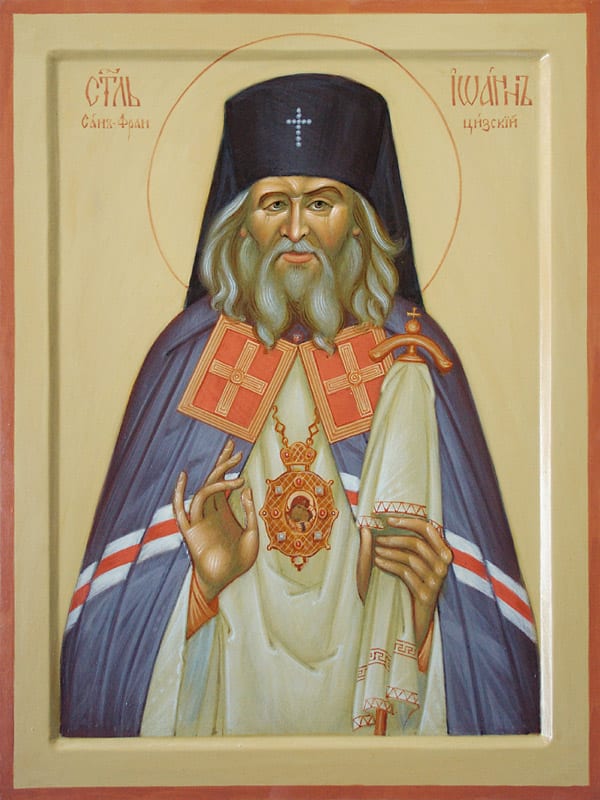
Icon of Saint John of Shanghai and San Francisco. By MKoala, via Wikimedia Commons, CC BY-SA 4.0.
There is a saint of our own century who was born within a day’s ride of Kharkiv, in the black-earth country of eastern Ukraine, and who died a bishop in America, where his body rests to this day, incorrupt, in a cathedral in San Francisco. His name is John. The Church calls him the Wonderworker. Simple people who knew him called him John the Barefoot. He was born in Kharkiv, in Ukraine, and he became a saint in the very country where our parish now stands. His feast falls on July 2.
This page is for parishioners who want to know a saint of their own time and their own soil, and for anyone, anywhere, who wonders how a stammering little bishop born under the last Tsar came to sanctify a city on the Pacific. It is meant to be the fullest and most careful account of his life we could gather, drawn from the ROCOR service and hagiography, from Bishop Alexander Mileant’s Life and Miracles, from the eyewitness account of the opening of his relics, and from his own written words.
At a glance
- Names: John (Maximovitch / Maximovich / Maksimovich); born Michael Borisovich Maximovitch. Called Vladyka John, John the Barefoot, Blessed John the Wonderworker.
- Born: June 4, 1896, in Adamivka, Kharkiv region (then Kharkov governorate of the Russian Empire; today Ukraine).
- Reposed: July 2, 1966, in Seattle, Washington, at the age of 70.
- Offices: Bishop, later Archbishop, of Shanghai (1934 to 1949); Archbishop of Western Europe (1951 to 1962); Archbishop of Western America and San Francisco (1962 to 1966).
- Glorified: July 2, 1994, by the Russian Orthodox Church Outside Russia; universal veneration recognized by the Moscow Patriarchate in 2008.
- Feast: July 2 (June 19 on the old calendar); the uncovering of the relics, October 12.
- Shrine: Holy Virgin Cathedral “Joy of All Who Sorrow,” San Francisco, where his incorrupt relics rest.
A saint of our own century
Most of the saints we honor lived long ago and far away. Saint John Maximovitch did not. He was born in 1896 and died in 1966. There are photographs of him, not icons only but photographs, black and white, of a stooped little bishop with burning eyes walking barefoot through the slums of Shanghai and the refugee camps of the Pacific. Men and women are still alive who received his blessing.
His whole life is the answer to a question many of us carry: can holiness survive exile? Can a soul torn out of its homeland, carried across oceans, planted in a strange country, still become a saint? In Saint John the answer stands before us, incorrupt. He was born in Kharkiv and glorified on the shores of America, and he shows anyone who has ever left home that the faith does not weaken in exile. It deepens.
From Kharkiv: a quiet, pious boy
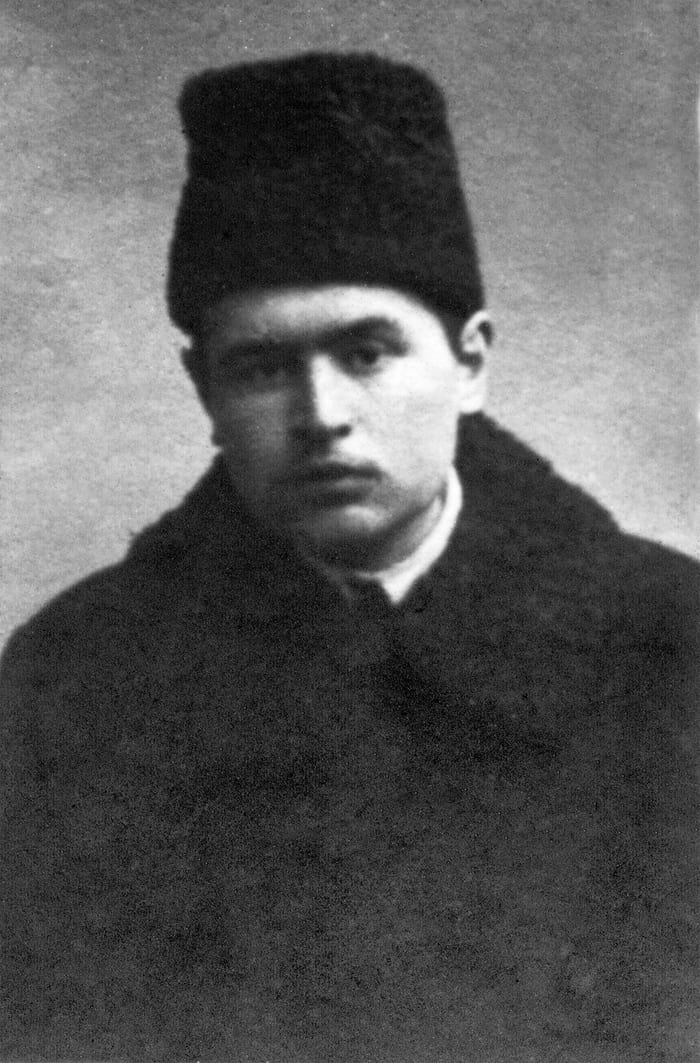
Michael Maximovitch as a young man in Kharkiv, before he became the monk John. Wikimedia Commons (Public Domain).
He was born Michael Borisovich Maximovitch on June 4, 1896, in the village of Adamivka in the Kharkiv region of Ukraine, the son of Boris and Glafira Maximovitch, a pious family of the old nobility. By family tradition the Maximovitch line reached back to another saint, Saint John of Tobolsk, the eighteenth-century missionary bishop of Siberia, and it was this holy kinsman whose name Michael would one day receive.
He was a sickly, serious child, more drawn to the lives of the saints than to the games of other children. He would later say that his parents “kindled in me a striving to stand unwaveringly for the truth.” He studied at the Poltava military school and then took a law degree at the Imperial University of Kharkiv, graduating in 1918, and briefly served in the Kharkiv courts. Then the world he knew was swept away. The revolution and the civil war drove his family, like so many of our people, into exile. They fled south and across the sea to the Kingdom of Serbia.
Belgrade: the making of a monk
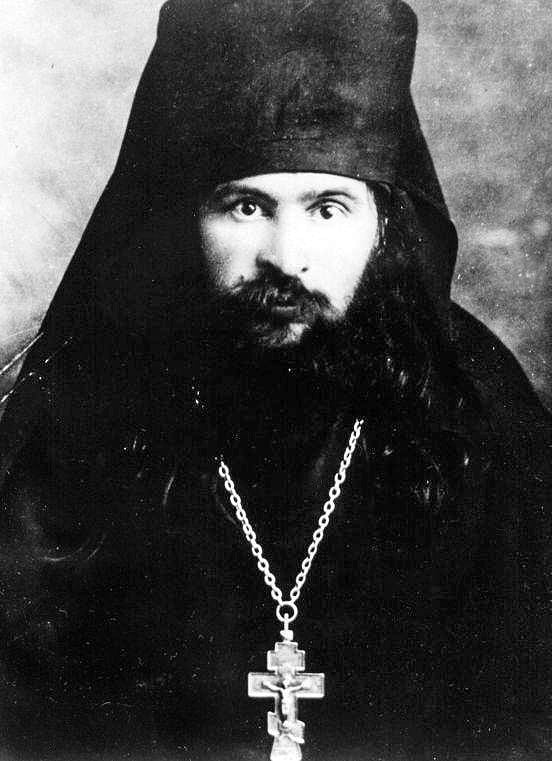
Hieromonk John in Belgrade, 1934, shortly before his consecration as bishop. Wikimedia Commons (Public Domain).
In Serbia, Michael entered the University of Belgrade and studied theology, graduating in 1925 while supporting himself and his family by selling newspapers. In 1926 he was tonsured a monk and given the name John, after his ancestor of Tobolsk, and was ordained to the holy priesthood, a hieromonk, that same year.
From the first he lived as an ascetic of the old kind. He ate once a day. He kept the whole daily cycle of services without fail. And, most famously, he would not lie down to sleep. For more than forty years, from the day of his monastic vows to the end of his life, he took what little rest he took sitting upright in a chair or on his knees before the icons. Those who lived with him thought him a fool for Christ. They were not entirely wrong.
He was sent to teach at the Serbian seminary of Saint John the Theologian in Bitol, and there his holiness was already remarked. The service to the saint preserves the words of a Serbian bishop who told his people: “If you wish to see a living saint, hasten to the city of Bitol, and there look upon Father John.”
Shanghai: bishop of a city of refugees
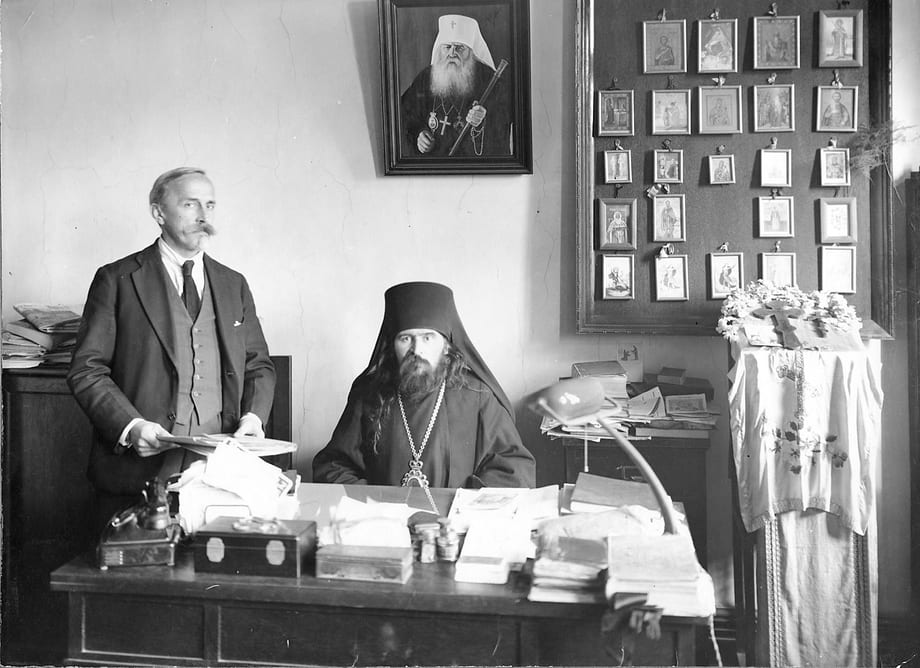
Bishop John in his office in Shanghai, beneath a portrait of Metropolitan Anthony and a wall of icons. Wikimedia Commons (Public Domain).
In 1934 he was consecrated a bishop and sent to Shanghai, where tens of thousands of Russian and Ukrainian refugees had washed up after fleeing the Soviet terror. He found a community in disarray and left it a diocese. He completed a great cathedral in honor of the icon of the Mother of God, “the Surety of Sinners.” He built and served hospitals, a home for the aged, and above all an orphanage placed under the patronage of Saint Tikhon of Zadonsk, which gathered the abandoned children of the city off the streets and out of the brothels and gave them a childhood. It began with a handful of children and held as many as a hundred at a time; by the accounts of his biographers, well over a thousand children, by some accounts three thousand, passed through it over the years.
He himself would walk the worst quarters of Shanghai at night, looking for sick and starving children, and carry them home in his own arms. He visited the hospitals, the prisons, and even the asylum, where the mentally ill, who frightened everyone else, received him peacefully. He was often barefoot. He was small, stammering, strange to look at, and utterly without fear, and the whole city, Orthodox and pagan alike, came to know that the little bishop was a holy man. In 1946 he was elevated Archbishop.
Tubabao: the bishop who moved a nation
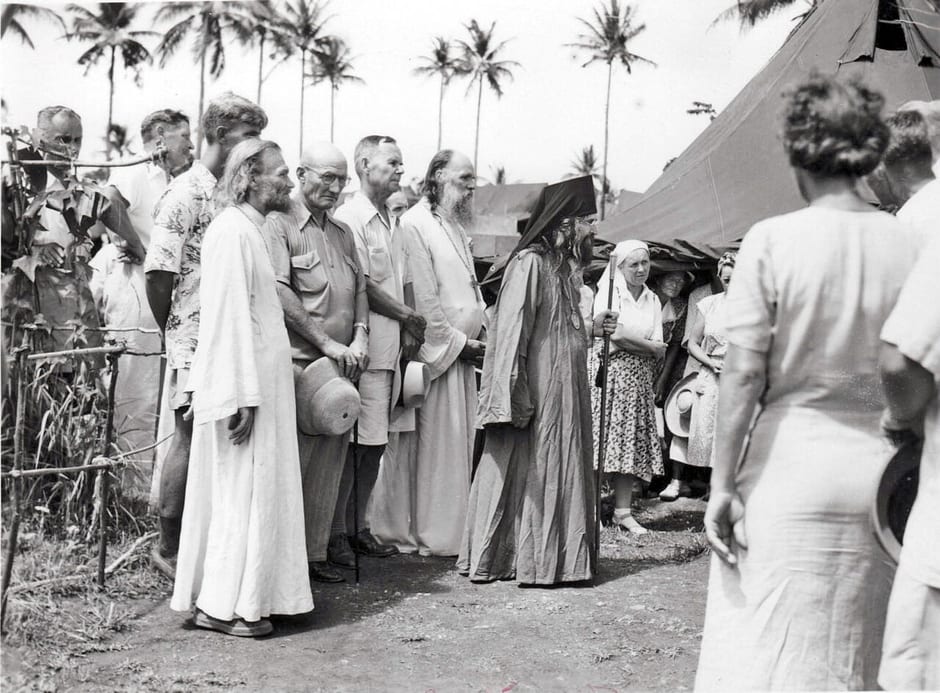
Archbishop John among his flock at the refugee camp on Tubabao Island, 1949. Wikimedia Commons (Public Domain).
When the communists took China in 1949, his people faced a second exile. Saint John led some five thousand of them out of Shanghai to a tent camp on the island of Tubabao in the Philippines. The island lay in the path of the seasonal typhoons, and everyone knew it. Yet in the more than two years the refugees waited there, the great storms turned aside. The Filipino residents said that a holy man walked the camp each night, blessing it toward the four winds; when at last a typhoon did strike, after the camp had emptied, it destroyed what was left. This is what the refugees and their neighbors reported, and it is recorded in the accounts of his life.
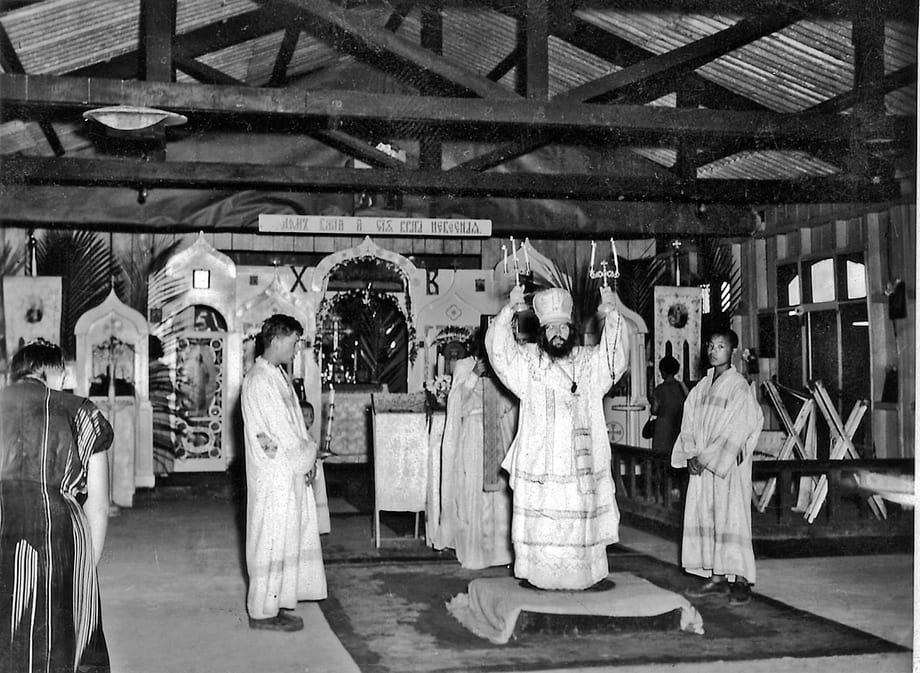
Archbishop John serving the Divine Liturgy in the tent “cathedral” on Tubabao, lifting the episcopal candles. Wikimedia Commons (Public Domain).
Getting his people off the island and into safety was the labor of a mountain-mover. Saint John went himself to Washington and would not rest until the immigration laws had been bent to open a door, and nearly the whole camp was resettled in the United States, in Australia, and beyond. He had saved them once from the Bolsheviks and now a second time from the sea, and he did it, as he did everything, by prayer joined to relentless, practical love. The whole episode is the subject of a scholarly book, John B. Dunlop’s Exodus.
The barefoot years: Western Europe
From 1951 he served as archbishop in Western Europe, with his cathedra first in Paris and later in Brussels, gathering the scattered Orthodox of many nations and caring for French and Dutch Orthodox as well as his own Russian and Ukrainian flock. He loved the ancient saints of the West who had lived before the schism, and labored to restore their veneration. It was here, in the streets of Paris, that he won the name by which simple people loved him. A Catholic priest is said to have told his own young people to take heart, for “today there walks in the streets of Paris a saint, Saint Jean Nus Pieds,” Saint John the Barefoot.
San Francisco: the last city, and the trial
In 1962 he was sent to his last and greatest city, San Francisco, where the Russian and Ukrainian emigration had gathered and where a magnificent cathedral in honor of the icon “Joy of All Who Sorrow” stood unfinished, its community divided. He brought the work to completion. For his pains he was slandered. In the mid-1960s a faction of the cathedral board took him to civil court, accusing him of concealing irregularities in the cathedral funds, and the case made the San Francisco newspapers. He was made to suffer the humiliation of a public trial, from which he emerged wholly vindicated. He bore it all in silence, as the saints bear such things, and those who loved him believed the sorrow of it hastened his end.
Repose in Seattle: July 2, 1966
He was widely said to have foretold the time and place of his death: that he would die soon, at the end of June, not in San Francisco but in Seattle. On July 2, 1966, while visiting Seattle with the wonderworking Kursk-Root Icon of the Mother of God, he served the Divine Liturgy that morning, prayed unusually long in the altar afterward, and then reposed in his room, seated, in the presence of the icon, as he had lived. He was seventy years old. His body was carried back to San Francisco and entombed in a sealed sepulcher beneath the altar of the cathedral he had finished.
The ascetic and the man
If the miracles make him a wonderworker, it is the daily austerity, kept in secret for forty years, that makes him a saint. The details are concrete and they are all attested by those who lived beside him.
- He never lay down in a bed after taking his monastic vows. He slept an hour or two, sitting in a chair or prostrate on the floor before his icons; servers sometimes found him in the morning huddled in the icon corner. The Canon to the saint sings it plainly: “You did not give sufficient sleep to your eyes, nor did you lie upon a bed to take your rest.”
- He ate once a day, late at night. During the first and last weeks of Great Lent he ate nothing at all, and in the fasts he took only prosphora, the altar bread.
- He went about in the cheapest clothing, in sandals without socks, and often barefoot, sometimes because he had given his shoes away to a poor man. He even served the Liturgy barefoot.
- He celebrated the Divine Liturgy every single day of his priestly and episcopal life, and if he could not serve, he still received the Holy Mysteries.
- He visited the sick every day, at any hour of the day or night, to hear confession and give Communion, and he alone could quiet the violent and the mad.
He was small and frail, almost childlike, with a speech impediment that made his sermons hard to follow; he protested his own election as bishop on the grounds that he could not speak clearly. He was strict about reverence in the church, allowing no idle talk in the altar and correcting mistakes on the spot, and yet those who knew him remember his gentleness and his joy, how he would smile and joke with the boys who served with him. Strictness and tenderness lived in him together, which is how it usually is with the saints.
Accounts and testimonies
Saint John is remembered above all as a wonderworker, in his lifetime and after his repose. The Church does not ask anyone to believe a list of marvels; what follows is offered as it should be, as the testimony of named witnesses, chiefly as gathered by Bishop Alexander Mileant in his Life and Miracles and in the collections kept at the cathedral in San Francisco.
In his lifetime, witnesses reported the healing of the desperately ill after he gave them Communion, and told of the protection of the Tubabao camp from the typhoons. They said he knew the contents of letters before opening them and recognized people he had never met, that he named at a hospital bedside who would recover and who would die, and that a soldier’s fractured skull and a woman’s ruined hand were made whole after his prayer. One woman, Anna Lushnikova, said he appeared to her in a French hospital far away and left behind, as she put it, a token of his visit.
After his repose, his tomb beneath the cathedral at once became a place of pilgrimage; the sick were healed there and the sorrowful comforted, and people left written petitions folded at the sepulcher. Within forty days some said they saw him in the light of Pascha. To one grieving woman he is said to have appeared with the message that passed into the very hymns of his feast: “Tell the people: although I have died, I am alive.” Healings have been attributed to the oil from his relics and to his icon down to our own day, reported from San Francisco, from Moscow, and from many other places.
The incorrupt relics, and his glorification
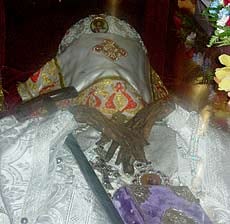
The incorrupt relics of Saint John in the Holy Virgin Cathedral. By Tgrain, via Wikimedia Commons, CC BY-SA 3.0.
In October 1993, twenty-seven years after his burial, his sepulcher was opened before witnesses, among them Archpriest Peter Perekrestov, who wrote down what he saw. When the rusted key would not turn, one of the bishops read the Fiftieth Psalm and the lid opened with ease. The body was found incorrupt, the face and the hands intact. On July 2, 1994, on the anniversary of his repose, Saint John was solemnly glorified as a saint by the Russian Orthodox Church Outside Russia, in the cathedral he had completed. After the reconciliation of the Russian Church, his universal veneration was recognized by the Moscow Patriarchate in 2008. His feast is now kept across the Orthodox world, and the uncovering of his relics is commemorated on October 12.
Visit the shrine
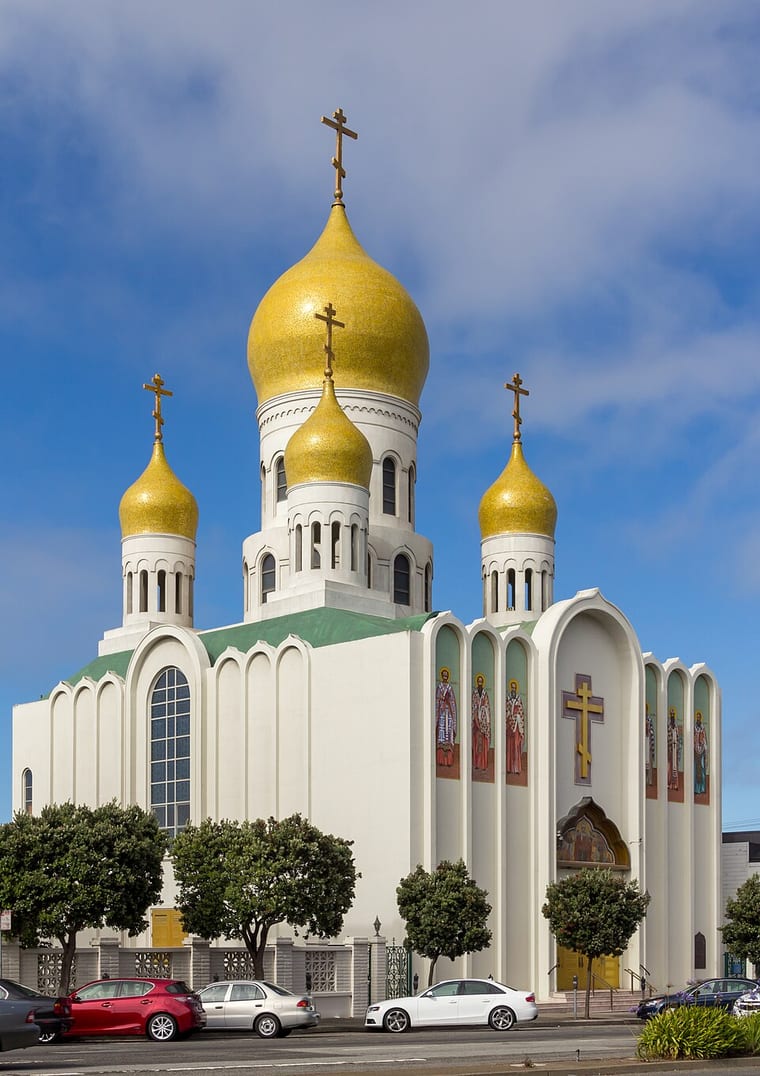
Holy Virgin Cathedral “Joy of All Who Sorrow,” San Francisco, where Saint John’s relics rest. By Mike Peel (www.mikepeel.net), via Wikimedia Commons, CC BY-SA 4.0.
The incorrupt relics of Saint John rest in a shrine in the Holy Virgin Cathedral “Joy of All Who Sorrow” on Geary Boulevard in the Richmond District of San Francisco (6219 Geary Boulevard, San Francisco, CA 94121). The cathedral is the largest of the ROCOR cathedrals, and the clergy who keep it call the shrine the most-visited place of Orthodox pilgrimage in America. Pilgrims from every Orthodox people, our own among them, still come to venerate the relics, to ask his prayers, and to leave, folded at his feet, their written petitions to a bishop who never turned anyone away.
Why we honor him
Saint John was born in Kharkiv, in Ukraine, and shaped by the same catastrophe of exile that scattered so many of our own grandparents across the world, and he was made holy not in spite of that exile but through it. He carried the faith of his native Kharkiv steppe to China, to the Philippines, to Paris, to America, and it lost none of its power in the carrying. He served Russians and Ukrainians and Serbs and Frenchmen and Chinese alike, for his love, as his akathist says, knew no bounds of country or race; and he is venerated today across the whole Orthodox world.
That is why we set his icon among the saints we honor. To anyone who has left home and feared that something holy was left behind at the border, Saint John answers with his own incorrupt body: the faith travels, the saints travel, and a soul planted in a new land can bear the oldest and truest fruit.
The feast: July 2
The Orthodox Church keeps the feast of Saint John of Shanghai and San Francisco on July 2 on the New Calendar that our parish follows (June 19 on the old calendar), the day of his repose in 1966. By the tradition of his own cathedral, the service to the saint is chanted on the Saturday closest to July 2. When his feast falls on or near a Sunday, we lift his name in the Divine Liturgy and sing his hymns. Watch the bulletin at the start of July.
Iconography
In his icons Saint John is shown as a bishop, small and slightly stooped, in the black monastic klobuk and the bishop’s vestments, the omophorion with its crosses across his shoulders. He blesses with his right hand and holds the Gospel, or the crozier, or a scroll, in his left. His face is thin and intent, framed by a grey beard, the face of a man who did not sleep. Sometimes he is painted with the cathedral of San Francisco or the icon “Joy of All Who Sorrow” beside him, and sometimes with the children of his orphanage gathered at his feet. When you find his icon in our church, light a candle and ask the prayers of the bishop who prayed for everyone.
His own words
Saint John was a genuine theologian as well as a wonderworker; his essay The Orthodox Veneration of the Mother of God is still read across the Orthodox world. A few of his own lines, from his sermons and letters:
The present night is not an ordinary night. Brighter than day, it fills our souls with light. Even if you are burdened by sins, do not turn away; for today even those in the bonds of hell hasten to the Light.
From his Paschal Epistle, Shanghai, 1940.
Nothing is fearful for the person whose hope is in God. He does not fear men who work evil.
From a spiritual message, 1937.
To strike a blow at her veneration means to strike Christianity at the root, to destroy it in its very foundation. Merciful and full of love, she manifests her love towards her Son and God in love for the human race.
On the Mother of God, from The Orthodox Veneration of the Mother of God.
He comes to us not for punishment and judgment, but for our salvation. To the Lord lying in the manger, together with doxology and praise, let us each bring from our hearts some kind of good deed.
From his Nativity message, 1935.
Troparion, Kontakion, and hymns
Troparion, Tone 5
Lo, your care for your flock in its sojourn prefigured the supplications which you ever offer up for the whole world. Thus do we believe, having come to know your love, O holy hierarch and wonderworker John. Wholly sanctified by God through the ministry of the all-pure Mysteries, and yourself ever strengthened thereby, you hastened to the suffering, O most gladsome healer. Hasten now also to the aid of us who honor you with all our heart.
Alternate Troparion, Tone 1
You increased the gift of the episcopacy, imitating the apostles in the preaching of the word, and for your vigils, fasting, and prayer you were reckoned among the venerable, enduring slander and mockery with meekness. Therefore Christ has glorified you with miracles, which you pour forth in abundance upon all who have recourse to you with faith. Save us now by your supplications, O right wondrous John, holy hierarch of Christ.
Kontakion, Tone 4
Following Christ, the Chief Shepherd, you were shown to be most excellent among hierarchs; for you did save your sheep from destruction by the godless, arranging a tranquil refuge for them; and exercising unceasing care for your flock, you did heal the infirmities of their souls and bodies. Entreat Christ God now for us who fall down before your precious relics, O father John, that our souls may be saved in peace.
Magnification
We magnify you, O holy hierarch John, and we honor your holy memory; for you pray to Christ our God.
English translation of the Troparion, Kontakion, and Magnification by Isaac E. Lambertsen (copyright 2002), from the ROCOR service to the saint. Reproduced here for prayer.
Read the full Akathist to Saint John the Wonderworker
The complete akathist, in the modern-English redaction published by Orthodox Mission Church (Arizona); an older liturgical redaction was compiled by Hieromonk Seraphim (Rose). Reproduced here for prayer. The full service and akathist are also available from the Holy Virgin Cathedral, San Francisco.
Kontakion 1
Chosen wonderworker and superb servant of Christ, who pours out in the latter times inexhaustible streams of inspiration and multitude of miracles. We praise you with love, and call out to you: Rejoice, O holy Hierarch John, Wonderworker of the latter times.
Ikos 1
An angel in the flesh you were manifested in the latter times by the grace of God Who cares for men. Seeing the beauty of your virtues, we, your children, now cry out to you:
Rejoice, you live in virtue from earliest childhood.
Rejoice, you always live in fear of God and do His holy will.
Rejoice, you manifest the grace of God in numberless virtues.
Rejoice, you mystically hear the distant prayers of those in distress.
Rejoice, you were filled with love for your fellow men and did all that was possible for their salvation.
Rejoice, you bring joy to all who pray to you in faith and love.
Rejoice, O holy Hierarch John, Wonderworker of the latter times.
Kontakion 2
Seeing the abundance and variety of your virtues, O holy Hierarch, we see in you a living source of God’s wonders in our time. You refresh with your love and miracles all who cry in faith to God: Alleluia!
Ikos 2
Being filled with love, you were also filled with theology, O holy father. And in you the knowledge of God flowed forth again in love for suffering men. You teach us also to know the true God in love as we call out to you in admiration:
Rejoice, firm stronghold of Orthodox truth.
Rejoice, precious vessel of the gifts of the Holy Spirit.
Rejoice, righteous accuser of impiety and false doctrine.
Rejoice, ardent doer of the commandments of God.
Rejoice, severe ascetic who gave yourself no repose.
Rejoice, loving shepherd of the flock of Christ.
Rejoice, O holy Hierarch John, Wonderworker of the latter times.
Kontakion 3
By God’s mercy you were manifested as a father to orphans and instructor of the young, raising them in the fear of God and preparing them for the service of God. Therefore, all your children look to you with love and cry out with gratitude to God: Alleluia!
Ikos 3
Dwellers in heaven should be praising you and not we on earth, for our words are feeble beside your deeds. Yet offering to God what we have, we cry out to you:
Rejoice, you protected your children by your constant prayer.
Rejoice, you guarded your flock by the sign of the Cross.
Rejoice, your love knew no bounds of country or race.
Rejoice, bright luminary beloved by all.
Rejoice, model of spiritual meekness.
Rejoice, giver of spiritual consolation to those in need.
Rejoice, O holy Hierarch John, Wonderworker of the latter times.
Kontakion 4
Bewildered by your deeds of piety and love, we know not how to praise you worthily, O Hierarch John. You traveled to the ends of the earth to save your people and preach the gospel to those in darkness. Thanking God for your apostolic labors, we cry out to Him: Alleluia!
Ikos 4
The people of many lands beheld your life and marveled at God’s mercies even in these latter times. And so we also, marveling, cry out in awe:
Rejoice, enlightener of those in the darkness of unbelief.
Rejoice, you followed your people to the farthest East and West.
Rejoice, fountain of miracles poured out by God.
Rejoice, loving chastiser of those who have gone astray.
Rejoice, speedy comfort to those who repent of their sins.
Rejoice, support of those who are on the right path.
Rejoice, O holy Hierarch John, Wonderworker of the latter times.
Kontakion 5
You were manifested as a vehicle of God’s power to stop the destructive forces of fallen nature, O holy Hierarch, preserving your people on the island from the deadly wind and storm by your prayer and the sign of the Cross, so preserve us also who cry out in wonder to God: Alleluia!
Ikos 5
All who have trusted in your help in desperate circumstances and adversities have found deliverance, O bold intercessor before the Throne of God. Therefore, we too place our hope in you to protect us in dangers by your prayers before God as we call out to you:
Rejoice, you stopped the powers of nature from doing harm to your flock.
Rejoice, you provided by your prayer for all in need.
Rejoice, inexhaustible bread for the hungry.
Rejoice, abundant wealth for those who live in poverty.
Rejoice, consolation for those in sorrow.
Rejoice, quick uplifter for those who have fallen.
Rejoice, O holy Hierarch John, Wonderworker of the latter times.
Kontakion 6
You were manifested as a new Moses, leading his flock out of slavery, O Hierarch John. Deliver us also from slavery to sins and the enemies of God, as we cry out to God: Alleluia!
Ikos 6
You did the impossible and persuaded the authorities of this world to have pity on your flock, O good shepherd. Pray for us now that we may live in peace and quiet, saving our souls as we gratefully cry to you:
Rejoice, helper of all who call upon you in faith.
Rejoice, you deliver from death and disaster.
Rejoice, you preserve from lies and slander.
Rejoice, preserver of the innocent from bonds.
Rejoice, you foil the attacks of the unrighteous.
Rejoice, destroyer of lies and exalter of truth.
Rejoice, O holy Hierarch John, Wonderworker of the latter times.
Kontakion 7
O lover of the saints of East and West, you restore to the Orthodox Church the saints of the West, of lands which had fallen away from the truth. Now with these saints, pray for us to God as we on earth cry out to God: Alleluia!
Ikos 7
O fervent venerator of the holy Hierarchs of Gaul, you were manifested in the latter times as one of them, exhorting your flock to preserve the same Orthodox faith they confessed, and astonishing the peoples of the West by your holy life. Now preserve us in that same faith as we cry out to you:
Rejoice, new Martin by your miracles and ascetic feats.
Rejoice, new Germanus by your confession of the Orthodox faith.
Rejoice, new Hilary by your divine theology.
Rejoice, new Gregory by your love for God’s saints.
Rejoice, new Faustus by your gentle love and monastic fervor.
Rejoice, new Caesarius by your firm yet loving rule of the Church of God.
Rejoice, O holy Hierarch John, Wonderworker of the latter times.
Kontakion 8
At the end of your life, O holy Hierarch, you were called to the new world, to offer your witness of ancient Christianity and to suffer persecution for your righteousness, thus perfecting your soul for Heaven. Now marveling at your patience and long-suffering, we all cry out to God: Alleluia!
Ikos 8
O laborer of Christ’s vineyard who knew no rest even at the end of your much toiling life, help us now in our labors as we strive to be faithful to Christ, crying out in praise to you:
Rejoice, you endured to the end and so attained salvation.
Rejoice, you were deemed worthy to die before the icon of the Mother of God.
Rejoice, you kept your faith and courage in the midst of unjust persecution.
Rejoice, you labored to the end for your flock and met death sitting as a hierarch.
Rejoice, you returned through the air to be buried amid the flock.
Rejoice, you work wonders for those who come to your sepulcher with faith and love.
Rejoice, O holy Hierarch John, Wonderworker of the latter times.
Kontakion 9
All angels rejoiced at your soul’s ascent to their celestial home, marveling at the wonders you performed on earth through the action of the Holy Spirit, to whom we sing: Alleluia!
Ikos 9
Orators find it impossible to describe your life of sanctity with their many and eloquent words, O righteous John, for you became a living house for the power of the ineffable God. Yet, unable to fall silent at the wonder shown to our age of feeble faith, we glorify you:
Rejoice, divine palace where the counsel of the Good King is given.
Rejoice, small and humble abode containing the spacious beauty of angels’ mansions.
Rejoice, you gained a house not made with hands, eternal in the heavens.
Rejoice, infirmary wherein all manner of diseases are divinely healed.
Rejoice, closet wherein your holy labor of prayer was hidden.
Rejoice, blessed temple of the Holy Spirit.
Rejoice, O holy Hierarch John, Wonderworker of the latter times.
Kontakion 10
Wishing to save the world, the Savior of all has sent a new saint among us and through him has called us out of the dark recesses of sin. Hearing this call to repentance, the unworthy ones in turn cry out to God: Alleluia!
Ikos 10
You are a wall sheltering us from adversity, O Hierarch John, for through your heavenly intercessions we are delivered from the attacks of demonic passions and from afflictions which beset us on earth. Before your firm support of prayer, we cry with faith:
Rejoice, sight to the blind.
Rejoice, strength and life to those on the bed of death.
Rejoice, God-revealed advice to those in doubt and confusion.
Rejoice, refreshing water to those perishing in the heat of sorrow.
Rejoice, loving father to the lonely and abandoned.
Rejoice, holy teacher of those who seek the Truth.
Rejoice, O holy Hierarch John, Wonderworker of the latter times.
Kontakion 11
Your life was a hymn to the Most Holy Trinity, surpassing others in thought, word and deed, O most blessed John. For with much wisdom, you explained the precepts of the true Faith, teaching us to sing with faith, hope and love to the one God in Trinity: Alleluia!
Ikos 11
We see you as a radiant lamp of Orthodoxy amid the darkness of ignorance, O God-chosen pastor of Christ’s flock, our father John. For even after your repose you speak the truth to the ignorant and give instruction to those who seek guidance to all who cry to you:
Rejoice, radiance of divine wisdom to those in ignorance.
Rejoice, rainbow of quiet joys for the meek.
Rejoice, thunder to stubborn sinners.
Rejoice, lightning of the zeal of God.
Rejoice, rain of God’s dogmas.
Rejoice, shower of theological thoughts.
Rejoice, O holy Hierarch John, Wonderworker of the latter times.
Kontakion 12
Grace has been poured out in the last days upon us all. Beholding this grace come forth from a holy Hierarch who once walked among us, let us receive it with reverence and thanksgiving, crying to God: Alleluia!
Ikos 12
Singing in praise to God, the heavenly choir of saints rejoices that He has not forsaken the fallen and unbelieving world, but has manifested His almighty power in you, His meek and humble servant, O blessed John. With all the saints we greet you and give honor to you:
Rejoice, new star of righteousness shining in heaven’s firmament.
Rejoice, new prophet who was sent before the final unleashing of evil.
Rejoice, new Jonah warning all of the wages of sin.
Rejoice, new Baptist drawing all to a life of prayer and repentance.
Rejoice, new Paul suffering to preach the gospel in the spirit of Truth.
Rejoice, new apostle whose miracles instill in us faith and awe.
Rejoice, O holy Hierarch John, Wonderworker of the latter times.
Kontakion 13 (read three times)
O holy and most wondrous Hierarch John, consolation for all the sorrowing, accept now our prayerful offering that through your prayers to our Lord we may be spared gehenna and by your God-pleasing intercession we may cry eternally: Alleluia! Alleluia! Alleluia!
(Then Ikos 1 and Kontakion 1 are repeated.)
A prayer for our parish
Holy Hierarch John, Wonderworker of Shanghai and San Francisco, who were born in Kharkiv, in Ukraine, and carried the faith unbroken across every sea: watch over this small Ukrainian parish on the Florida coast. You who fed the orphans of Shanghai and led your people through the storm to safety, gather our children into the faith and lead every exile among us home to Christ. Strengthen our priest and our faithful. Comfort all who have left Ukraine and grieve for it, and protect the land where you were born. Teach us, who also live far from where we began, that holiness has no homeland but heaven, and that the saints go with us wherever we are sent. Pray for us to the Lord, that we may stand with you and all the saints before the throne of the All-Holy Trinity, now and ever and unto ages of ages. Amen.
Come and pray with the saint of the exiles
Our parish gathers each Sunday for the Divine Liturgy.
| Time | Service |
|---|---|
| 9:30 AM | Hours and Confession |
| 10:00 AM | Divine Liturgy (Ukrainian and English) |
| ~11:30 AM | Coffee and fellowship in the parish hall |
Each year at the start of July, as the feast of Saint John (July 2) comes around, we remember the wonderworker of Shanghai and San Francisco and ask his prayers for our parish and for Ukraine. Watch the bulletin for the closest Sunday observance. All are welcome.
St. Michael Ukrainian Orthodox Church 9201 60th St, Pinellas Park, FL 33782 Phone: 727-777-4450
Further reading
- Fr. Seraphim (Rose) and Abbot Herman, Blessed John the Wonderworker (St. Herman of Alaska Brotherhood), the foundational account of his life and the first collection of testimonies.
- Archpriest Peter Perekrestov, Man of God: Saint John of Shanghai and San Francisco.
- John B. Dunlop, Exodus: St. John Maximovitch Leads His Flock Out of Shanghai (St. Vladimir’s Seminary Press).
- St. John Maximovitch, The Orthodox Veneration of the Mother of God, his best-known theological work.
Learn More
- Saints Volodymyr and Olha, the enlighteners of Rus-Ukraine
- Saint Job of Pochaiv, wonderworker of the Ukrainian land
- Becoming Orthodox, for those drawn to the faith of the saints
- The Divine Liturgy, the service in which we keep his feast
- Newcomers, general orientation to our parish