Saints Volodymyr and Olha, Equal-to-the-Apostles, Enlighteners of Rus-Ukraine
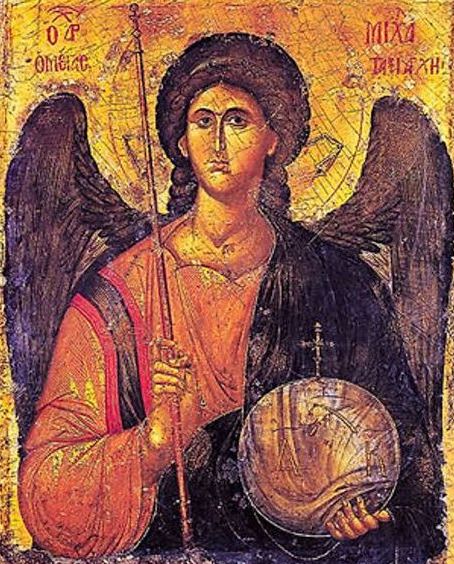
Every Ukrainian Orthodox parish, no matter how far from Kyiv, has two great-grandparents in the faith. Their names are Olha and Volodymyr. Without them, there would be no Ukrainian Orthodoxy, no thousand years of liturgy in our language, no domed churches above the Dnipro, no parish of St. Michael in Pinellas Park, Florida. The faith that we receive each Sunday in the Divine Liturgy reached us because, more than a thousand years ago, a princess and her grandson said yes to Christ.
This page is for parishioners who want to know their spiritual ancestors, and for visitors who wonder why a small Ukrainian parish on the Gulf coast looks back so often to a baptism in the Dnipro River in the year 988.
Why Volodymyr and Olha matter to our parish
The Orthodox Church gives the title Equal-to-the-Apostles (рівноапостольний) only to those whose lives turned whole nations to Christ. Saint Mary Magdalene received this title because she carried the news of the Resurrection. Saint Constantine the Great received it because he stopped the persecutions and gave the Empire to Christ. In the eastern Slavic lands, the same title belongs to two royal saints of Kyiv: the grandmother and the grandson, Olha and Volodymyr.
Saint Olha (княгиня Ольга) was the first ruler of Kyivan Rus to be baptized. She received the faith in Constantinople around the year 957, when much of her own court was still pagan. She is called the morning star of the Orthodox faith among our people, because she went first, and her light prepared the way.
Saint Volodymyr (князь Володимир) was her grandson. As a young prince he served the old gods. As a converted prince he led his people, by personal example and royal decree, into the Orthodox faith. In 988 he was baptized at Chersonesos in the Crimea, married the Byzantine princess Anna, returned to Kyiv, and led the people of his capital down to the Dnipro for the great baptism that we still remember as the founding moment of the Church among the eastern Slavs.
For a Ukrainian Orthodox parish, these two are not distant historical figures. They are the saints who gave us our faith. The language of our Liturgy, the shape of our icons, the calendar of our feasts, the very fact that a Ukrainian child can be baptized in Florida and grow up knowing the Jesus Prayer, all of this rests on the obedience of an old princess and the courage of a young prince who said, with their lives, that Christ is Lord.
Saint Olha, the morning star
Olha was the wife of Igor, prince of Kyiv, and after his murder by a rival tribe around 945 she ruled the realm as regent for their young son Sviatoslav. The Primary Chronicle remembers her as a woman of sharp judgment and fierce loyalty, who avenged her husband and held the throne for her son.
What the Chronicle remembers more carefully is what happened to her in Constantinople. Around 957 she traveled to the imperial city. She was received by the Emperor Constantine VII Porphyrogenitus. She saw the Liturgy at Hagia Sophia. She met the Patriarch. Somewhere in that long visit, in the gold and incense and chanting that fill the great church, the grace of God reached her, and she asked for baptism.
She was baptized by the Patriarch himself, with the Emperor as her godfather. She received the Christian name Helena, after the mother of Constantine, another Equal-to-the-Apostles. She returned to Kyiv as the first Christian ruler her people had known.
Her own son Sviatoslav refused the faith. She begged him; he answered that his warriors would mock him if he was baptized. She did not force him. She told him, in words the Chronicle preserves, that what God willed for her, He would also will for those who came after, if only they would receive Him. She lived and died in that hope. She was buried in Kyiv around 969 according to the Christian rite she had asked for, in a land still ruled by pagans.
She did not live to see the answer to her prayer. The answer came one generation later, in her grandson.
Saint Volodymyr, who led a nation to the Jordan
Volodymyr came to the throne of Kyiv around 980. He was, as a young man, what his pagan inheritance had made him: a fierce warrior, a builder of pagan shrines, the holder of many wives. He set up idols on the hill above his palace and offered sacrifice to them. The early Volodymyr is not a saint we hide. The Church remembers him as he was, because the change in him is the whole point.
He began to seek. The Chronicle tells of envoys sent to the great religions of his world: to the Bulgarian Muslims, who forbade pork and wine; to the German Christians of the Latin rite; to the Khazar Jews, whose loss of Jerusalem he could not understand; and at last to the Greeks of Constantinople. The envoys returned from Hagia Sophia with the famous words that have echoed for a thousand years: we knew not whether we were in heaven or on earth. They had seen the Divine Liturgy. They could not describe its beauty. They told their prince, “we know only that God dwells there among men, and that their service is fairer than the ceremonies of other nations.”
Volodymyr was persuaded. In 988 he marched on the Byzantine city of Chersonesos in the Crimea, captured it, and demanded the hand of the imperial princess Anna in marriage. The Emperors Basil and Constantine answered that no Christian princess could marry a pagan; he must be baptized first. He was baptized at Chersonesos, taking the Christian name Basil. The princess Anna came south to meet him, and they were married in the church there.
He returned to Kyiv with a Byzantine bride, Greek clergy, and an unshakable resolve. He ordered the great pagan idol of Perun, which he had himself erected, to be dragged down from the hill, beaten with sticks, and floated down the Dnipro. He called the people of Kyiv to the river. The Chronicle says he told them, “if anyone does not come, he will be against me,” and the people came willingly, because they trusted him and because, the Chronicle adds, “if this had not been good, the prince and the boyars would not have accepted it.”
Greek priests stood in the river. The men went into the water up to their necks, the women up to their breasts, the children near the shore, while the priests read the prayers of holy baptism. This was the Baptism of Rus, Хрещення Русі, on the banks of the Dnipro, in the year 988.
Volodymyr was not finished. He sent missionaries through his realm. He founded the Tithe Church (Десятинна церква) in Kyiv, the first stone church of Rus, and gave a tenth of his revenue to support it. He opened schools so that the children of his nobles could read Scripture in their own tongue. He turned away from his many wives. He fed the poor at his palace and sent food carts through the streets of Kyiv for those too sick to come. The Chronicle, which had nothing kind to say of him in his pagan years, ends his life with words of wonder: he had become, by the grace of God, a new man.
He died in 1015 and was buried beside Princess Anna in the Tithe Church he had built. The Church has venerated him as a saint and as Equal-to-the-Apostles ever since.
What Scripture says about saints like these
The Church does not invent the category of Equal-to-the-Apostles. It draws the title from Scripture, from the way the Apostles themselves describe what happens when whole peoples turn to Christ.
Acts 26:17-18 - Christ tells Paul on the road to Damascus that He is sending him to the Gentiles, “to open their eyes, that they may turn from darkness to light, and from the power of Satan to God, that they may receive forgiveness of sins and a place among those who are sanctified by faith in Me.”
Romans 10:14-15 - “How are they to call on Him in whom they have not believed? And how are they to believe in Him of whom they have never heard? And how are they to hear without someone preaching? And how are they to preach unless they are sent? As it is written, ‘How beautiful are the feet of those who bring good news.’”
Matthew 28:19-20 - The risen Christ commands the Eleven: “Go therefore and make disciples of all nations, baptizing them in the name of the Father and of the Son and of the Holy Spirit, teaching them to observe all that I have commanded you. And behold, I am with you always, to the end of the age.”
These passages describe what Olha and Volodymyr did. They did not write Gospels. They did not heal the sick by their shadow. But they brought a whole people to the waters of baptism, and they passed down the faith of the apostles, undiluted, to every generation that came after them. That is why the Church calls them equal in honor, though not equal in office, to the Twelve.
The feasts: two days in July
The Orthodox Church remembers Saint Volodymyr and Saint Olha on two separate days, nine days apart in the heart of summer.
Saint Volodymyr the Great is commemorated on July 15 in the Church’s calendar, the anniversary of his death in 1015. Parishes on the New Calendar keep it on July 15 of the civil calendar; parishes holding to the older Julian calendar observe it thirteen days later, on July 28.
Saint Olha, in holy baptism Helena, is commemorated on July 11, the anniversary of her death in 969. On the Julian calendar this falls on civil July 24.
Across the Ukrainian Orthodox world the feast of Saint Volodymyr is also kept as the Day of the Baptism of Rus-Ukraine (День Хрещення Київської Русі-України), a civil and ecclesiastical observance marking the 988 baptism in the Dnipro. In Kyiv on this day, processions still move down to the river. In Ukrainian parishes across America, including ours, we sing the troparion of the holy prince and remember that we are heirs of that morning a thousand and forty years ago.
If either feast falls on a Sunday at our parish, we lift the saint’s name in the Divine Liturgy and sing the festal hymns. Watch the bulletin in mid July each year.
Iconography of the holy enlighteners
In Orthodox iconography Saint Olha and Saint Volodymyr are most often painted standing together, the grandmother and the grandson, dressed in the royal robes of Kyivan Rus, crowned, holding crosses in their right hands.
The cross is not a symbol of office; it is the sign of their work. They did not hold their nation together by the sword alone, though they were rulers and warriors. They held their nation together by planting the cross. The icon shows them as bearers of that cross, the first Christian rulers of their people, joined across two generations in the same mission.
Saint Olha is often depicted as an older woman, sometimes with the model of a small church in her hand, the sign that she founded churches and prepared the way for a Christian realm. Her face is grave, watchful, the face of a regent who has seen her husband murdered and her son refuse the faith, who carries hope in spite of all of it.
Saint Volodymyr is depicted as a mature man with a forked beard, dressed in the long robes and fur-trimmed cap of a prince of Rus, sometimes holding a sword as well as a cross, the sign of a Christian sovereign. In some icons he stands beside his two martyred sons, Saints Borys and Hlib, the first saints canonized of native Rus, who chose to die rather than raise their hand against their brother. Volodymyr lived to see those two sons grow up Christian. Their lives were the fruit of his baptism.
When you enter our church, look for the icons of the saints of Rus-Ukraine on the icon stand or in the festal row. Light a candle before them. Ask their prayers for our parish, for our people, and for the land of Ukraine where they planted the cross.
Troparion of Saint Volodymyr
You resembled the merchant seeking goodly pearls, glorious sovereign Volodymyr. Sitting on the high throne of the mother of cities, God-saved Kyiv, testing and sending to the imperial city to know the Orthodox faith, you found Christ, the priceless pearl, who chose you as a second Paul, and shook off blindness in the holy font, both spiritual and bodily. Therefore we, your people, celebrate your falling asleep. Pray that the rulers of Rus may be saved with the multitude of those entrusted to them.
Kontakion of Saint Volodymyr
Imitating the great Apostle Paul in your old age, most glorious Volodymyr, you abandoned all that you had pursued in youth as childish foolishness. You exchanged the weapons of arms for the weapons of righteousness, and were filled with the wisdom of God. Now you stand crowned before Christ. Pray that all the Christian rulers of Rus and the multitude entrusted to them may be saved.
Troparion of Saint Olha
Giving your mind the wings of divine understanding, you soared above visible creation seeking God the Creator of all. When you had found Him, you received rebirth through baptism. As one who delights in the Tree of Life, you remain eternally incorrupt, ever-glorious Olha.
A prayer for our parish
Holy Equals-to-the-Apostles, Princess Olha and Prince Volodymyr, who brought our people out of darkness into the light of Christ and led them down to the Dnipro to receive holy baptism: watch over this small Ukrainian parish in Florida. Strengthen our priest, our faithful, and our children. Send your prayers ahead of every Ukrainian who comes to us seeking the faith of their grandmothers. Comfort those who have left Ukraine and grieve for it, and protect the land you enlightened. Lead all of us, by your example, to choose Christ above every other prince and every other god. Pray for us to the Lord, that we may stand with you and all the saints of Rus-Ukraine before the throne of the All-Holy Trinity, now and ever and unto ages of ages. Amen.
Come and pray with the enlighteners of our people
Our parish gathers each Sunday for the Divine Liturgy.
| Time | Service |
|---|---|
| 9:30 AM | Hours and Confession |
| 10:00 AM | Divine Liturgy (Ukrainian and English) |
| ~11:30 AM | Coffee and fellowship in the parish hall |
Each July, as the feasts of Saint Olha (July 24) and Saint Volodymyr (July 28) come around, we lift their names in the Liturgy and remember the Baptism of Rus-Ukraine of 988. Watch the bulletin for the closest Sunday observance. All are welcome.
St. Michael Ukrainian Orthodox Church 9201 60th St, Pinellas Park, FL 33782 Phone: 727-777-4450
Learn More
- Saint John of Shanghai and San Francisco, a Ukrainian-born wonderworker of our own century
- About Orthodoxy, a short introduction to the Orthodox faith
- Becoming Orthodox, for those drawn to the faith of Olha and Volodymyr
- The Jesus Prayer, the ancient prayer kept alive by the saints of Rus
- Newcomers, general orientation to our parish